
University of Michigan Vice President Arthur Lupia Highlights ARC as a National Strategic Asset for Research, Innovation, and National Security
For more than three decades, the Automotive Research Center (ARC) has brought together universities, industry, government, and the U.S. Army to tackle some of the most complex challenges in mobility, engineering, and national security.
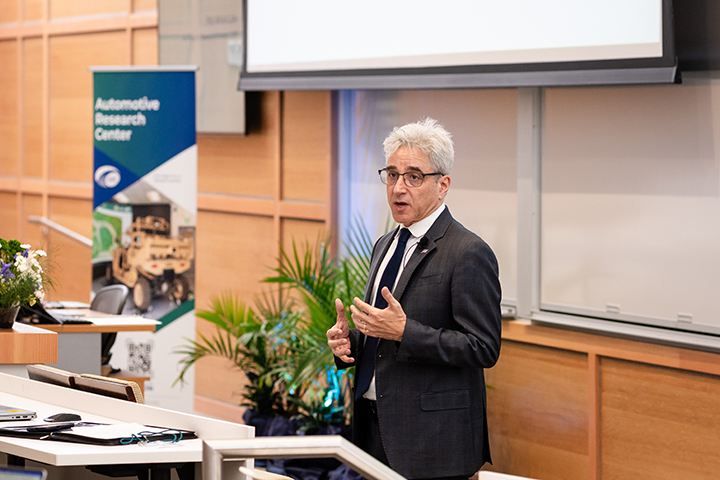
During the 32nd Automotive Research Center (ARC) Annual Program Review, University of Michigan Vice President for Research and Innovation Prof. Arthur Lupia reflected on that legacy and the partnerships that have sustained it, describing the ARC as “a unique national strategic asset” and a model for collaboration across academia, industry, government, and national security.
“For more than 30 years, the Automotive Research Center has served as a unique national strategic asset, a model for collaboration, innovation, and sustainability," Lupia said. “It’s one that spans industry, academia, public service, and national security."
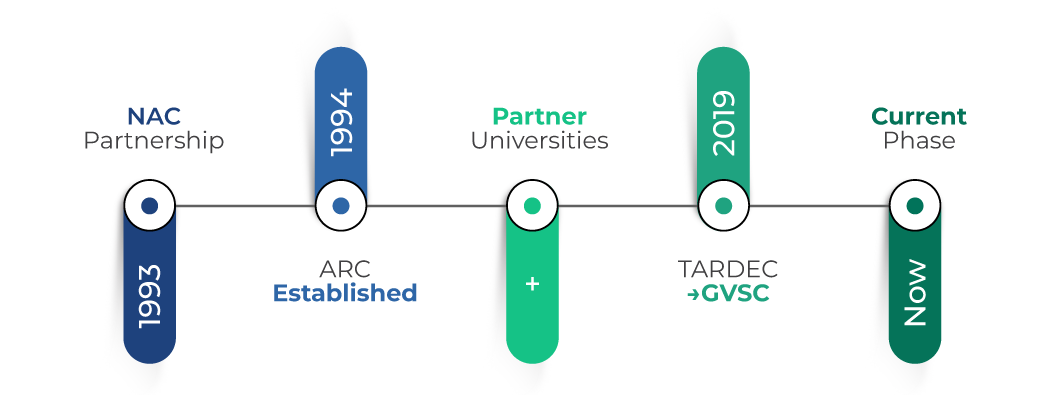
Tracing the ARC’s origins to a 1993 U.S. Army initiative that brought together a consortium of universities to address critical mobility challenges, Lupia highlighted how the center has evolved into one of the nation’s most enduring university-government research partnerships.
Today, the ARC includes more than fifteen universities and dozens of industry organizations working alongside the U.S. Army Ground Vehicle Systems Center (GVSC) to advance the science and technology foundations of future ground systems. The University of Michigan serves as the lead institution for this nationwide consortium.
Addressing faculty, students, Army researchers, industry representatives, and government leaders gathered in Ann Arbor for the Annual Program Review, Lupia emphasized that the ARC exemplifies the University’s mission to convene people with diverse expertise and perspectives to address challenges of national importance.
The Annual Program Review, organized around the theme “Digital Engineering for Automation through AI,” brought together participants from across the ARC consortium and its partners to explore advances in autonomy, human-machine teaming, digital engineering, advanced materials, intelligent power systems, and systems integration for future ground vehicle systems.
“We convene with purpose on a regular basis, bringing people together to serve our state, our nation, and the world through innovation," Lupia said. “Taking people with different types of expertise, different backgrounds, and thinking about how we can challenge each other, how we can inspire each other and change the world."
His remarks reflected a theme that has defined the ARC throughout its history: transformative innovation emerges when researchers, students, government leaders, industry partners, and Army stakeholders work together toward a shared mission.
A Partnership Born from National Need
Lupia recounted the ARC’s origins, when the U.S. Army issued a call for proposals through its newly chartered National Automotive Center in Warren, Michigan, to establish a university-based center of excellence in automotive research. In response, University of Michigan faculty led by Professor Panos Papalambros assembled a consortium that brought together the University of Michigan, Wayne State University, the University of Iowa, the University of Wisconsin–Madison, and Howard University.
Over the following decades, that original consortium evolved into one of the nation’s most successful university-government research partnerships. Today, the ARC spans more than fifteen universities and over thirty industry organizations, creating a collaborative ecosystem that advances research, education, workforce development, and national security.
Research, Education, and Public Impact
Lupia also highlighted the University’s responsibility to translate research into tangible public benefit while preparing future generations of leaders.
“We have a unique opportunity to provide the finest education to the next generation of leaders and to translate research into tangible and positive public impact,” he said.
That mission is reflected across the ARC research portfolio, which includes vehicle autonomous behaviors, human-autonomy teaming, high-performance structures and materials, intelligent power systems, and fleet-level systems-of-systems integration. Through its partnership with GVSC, the ARC has become a nationally recognized center for advancing digital engineering, modeling and simulation, autonomy, and next-generation mobility technologies.
Lupia noted that the ARC’s impact extends well beyond research publications and technical achievements. The center provides faculty and students with opportunities to work on real-world challenges affecting national security, transportation, manufacturing, and emerging technologies.
He highlighted several examples of ongoing ARC research, including efforts to improve the resilience of autonomous ground vehicles under physical and cyber threats, develop more effective human-machine interfaces for military crews, advance digital twin technologies for decision support, improve material characterization methods, and create innovative thermal management solutions for future military systems.
Because of these accomplishments, the ARC has been designated as a U.S. Army Center of Excellence for the modeling and simulation of ground vehicles and was recently renewed through a five-year agreement funded up to $100 million through 2028.
ARC Director Perspective
Prof. Bogdan Epureanu, Director of the Automotive Research Center, welcomed Lupia’s remarks and his recognition of the ARC’s long-standing mission.
“Dr. Lupia’s remarks captured the essence of what makes the ARC unique," said Epureanu. “For more than three decades, the ARC has demonstrated how sustained collaboration among universities, industry, and government can create lasting scientific, technological, and societal impact. We are proud to be part of a research ecosystem that advances national security while educating future leaders and strengthening American innovation."
Collaboration as a Force Multiplier
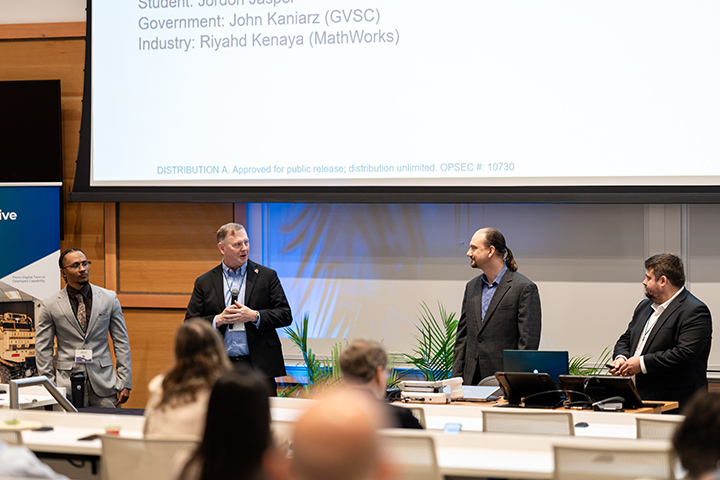
Lupia concluded by encouraging participants to take full advantage of the unique environment created by the Annual Program Review and the broader ARC ecosystem.
“We work better when we work together, and together we can have a huge impact," he said.
He encouraged attendees to strengthen relationships, learn from one another, and connect across disciplines and sectors, emphasizing that the opportunities created through collaboration are often as important as the technologies themselves.
GVSC Perspective
Dr. David Gorsich, Chief Scientist of the U.S. Army Ground Vehicle Systems Center, noted that Lupia’s remarks highlight a principle that has guided the ARC-GVSC partnership for decades.
“The ARC’s success stems from its ability to bring together diverse expertise from academia, industry, and government in pursuit of shared objectives," said Gorsich. “That collaborative model remains one of the most effective mechanisms for advancing the science and technology foundations needed for future Army capabilities."
More than thirty years after its founding, the ARC continues to demonstrate the enduring value of long-term partnerships among universities, industry, government, and the Army. As new challenges emerge in autonomy, artificial intelligence, digital engineering, and national security, the collaborative model that inspired the ARC’s creation remains as relevant today as it was in 1993.
Lupia’s remarks served as a reminder that the ARC’s greatest strength lies not only in its technical accomplishments, but also in its ability to convene people, institutions, and ideas in service of a larger mission. Through that collaborative approach, the ARC continues to advance research, education, and innovation that benefit the Army, the nation, and society as a whole.