

State of the ARC: Building the Digital Engineering Ecosystem for the Future of Army Transformation
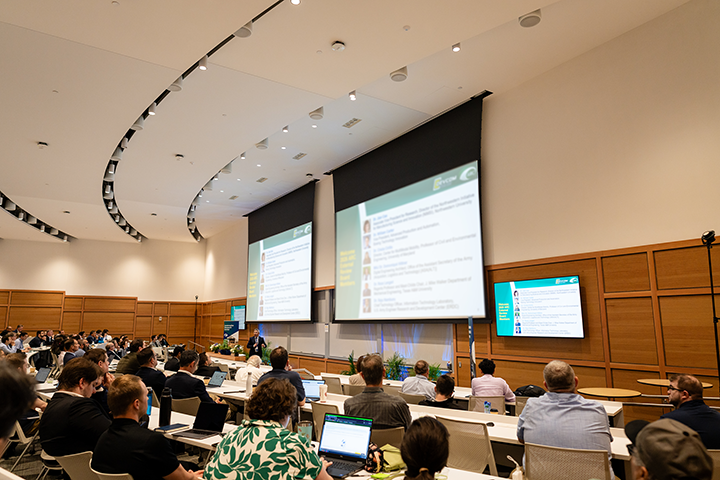
From engines and hybrid powertrains to reliability-based design, autonomous mobility, human-machine teaming, and digital engineering for multi-domain operations, for more than three decades, the ARC has continuously evolved alongside the technological challenges facing the U.S. Army. Throughout that evolution, one principle has remained constant: the need to understand and master complex mobility systems well enough to predict, assess, and improve their performance.
During the State of the ARC address at the 32nd ARC Annual Program Review, ARC Director Prof. Bogdan Epureanu and U.S. Army Ground Vehicle Systems Center (GVSC) Chief Scientist Dr. David Gorsich reflected on that legacy while outlining a vision for the next era of Army digital engineering and autonomy.
From Complexity to Capability
According to Gorsich, one of the defining characteristics of the ARC has been its ability to address increasingly complex systems while maintaining the computational efficiency required to support engineering decision-making.
Over the years, ARC researchers have pioneered approaches involving reduced-order models, surrogate models, metamodels, and other techniques designed to balance fidelity, uncertainty, and computational speed. These methods have enabled researchers to study interactions among materials, electronics, software, human operators, and vehicles without sacrificing practical usability.
Today, the pace of change is accelerating.
Artificial intelligence, foundation models, multimodal learning systems, and advances in computing are creating opportunities to address challenges that were previously beyond reach.
“The state of the ARC is great. Indeed, we’re generating new ideas … the whole modeling and simulation community is changing as we speak." Gorsich said as he reflected on the center’s evolution and its growing engagement with AI-enabled technologies.
He noted that many of the concepts currently attracting global attention, which include surrogate models, accelerated simulation, and data-driven prediction, have deep roots in research areas that the ARC has been advancing for decades. Today, the emergence of foundation models is creating opportunities to solve previously intractable problems involving uncertainty, complexity, and scale.
A Mission Built on Convergent Research Epureanu emphasized that the ARC’s mission is to develop cutting-edge modeling, simulation, and digital engineering capabilities. Such capabilities enable researchers to discover, assess, and advance critical ground systems for military-relevant operations.
The challenge is inherently multidisciplinary, spanning multiple physical scales, operational environments, and human-machine interactions.
“The state of the center is very strong, and our aspirations are very high," Epureanu said. “We aim to be the preeminent research organization for the United States Army in modeling, simulation and digital engineering, with a particular effort in converging research in autonomy."
That vision is anchored in the ARC’s focus on advanced off-road mobility and the multi-domain operation of heterogeneous teams of humans and adaptable autonomous vehicles. Through this work, researchers seek to answer questions surrounding adaptive autonomy, human-machine teaming, AI-enabled digital engineering, and accelerated capability transition.
One Ecosystem, Five Research Fronts
A central theme of the address was the ARC’s evolution from individual models toward integrated mission capabilities.
• Vehicle Dynamics, Control, and Autonomous Behavior
• Human-Centered Design and Human-Autonomy Teaming
• High-Performance Structures, Materials, and Terramechanics
• Intelligent Power Systems
• Fleet Operations and Systems Integration
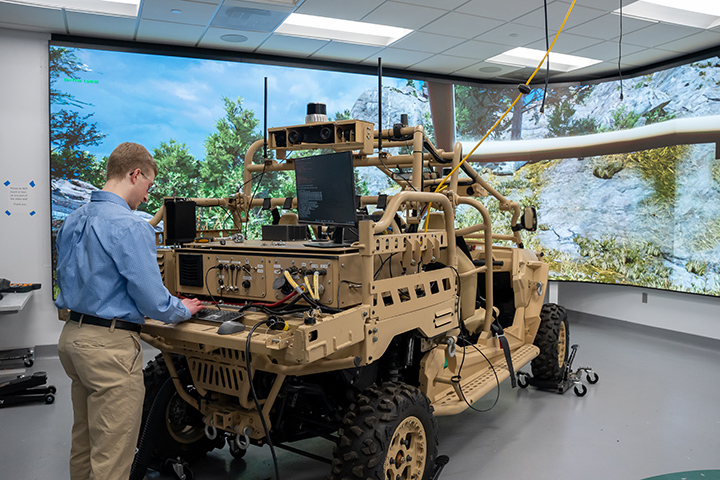
Together, these areas form an integrated digital engineering ecosystem supported by the ARC Digital Engineering Testbed, a research environment designed to enable modularity, interoperability, bi-directional integration, and AI-enabled experimentation.
Rather than treating each research front as separate challenges, the ARC seeks to integrate them into a common framework capable of supporting end-to-end capability development.
Responding to Army Transformation
The address also highlighted the ARC’s alignment with major Army transformation priorities, including scalable autonomy, human-machine integrated formations, digital engineering, and contested logistics.
To address these priorities, the ARC is building capabilities across multiple layers of intelligence:
• Physical Intelligence for adaptive autonomy in extreme environments.
• Cognitive Intelligence for human-machine teaming and operator state awareness.
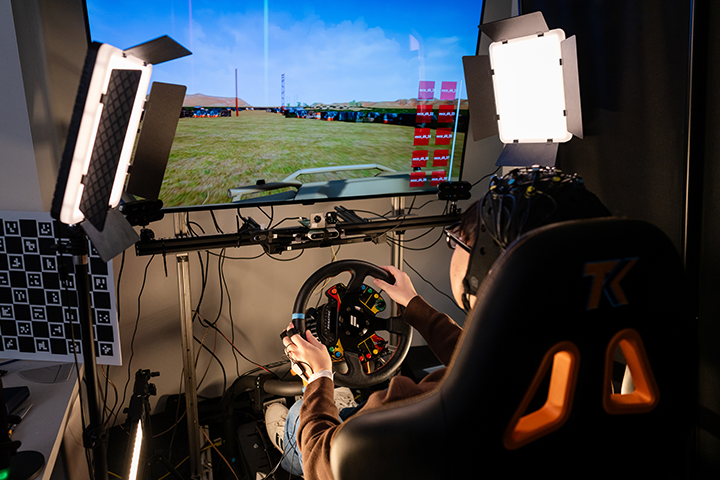
• Digital Intelligence for virtual validation and synthetic experimentation.
• Foundational Models and AI Agents enhanced by adaptive digital twins.
Together, these capabilities support a future in which intelligent systems can operate collaboratively, adapt to changing conditions, and accelerate decision-making across increasingly complex operational environments.
From Models to Mission Capabilities
Perhaps the most significant message of the address was that the ARC is entering a new phase of development.
The center’s focus is no longer solely on developing models. Increasingly, the objective is to translate those models into validated mission capabilities supported by a continuous digital thread connecting operators, autonomous systems, physical vehicles, synthetic environments, and mission objectives.
This vision is enabled by the ARC’s distinctive quad structure, which brings together Army scientists, academic researchers, industry engineers, and students as co-contributors throughout the research process. By integrating these perspectives from the outset, the ARC accelerates capability transition while maintaining scientific rigor.
Building the Next Generation of Army Capabilities
Looking ahead, both leaders emphasized that the ARC’s future lies at the intersection of artificial intelligence, digital engineering, autonomy, and orchestrated intelligence.
The goal is not simply to build smarter vehicles or more sophisticated models. It is to create integrated ecosystems capable of supporting human-machine teams, adaptive autonomy, and complex operations in contested environments.
As Epureanu concluded, the ARC is working to build today the capabilities that the Army will require tomorrow. Supported by strong scientific foundations, a growing digital engineering ecosystem, extensive validation infrastructure, and a collaborative workforce development model, the center is positioned to play a leading role in the next generation of Army transformation.
In the words of both speakers, the conclusion was straightforward: The state of the ARC is strong. The opportunities ahead are ever greater.