

From Platforms to Formations: COL Ken Bernier Outlines the Future of Autonomous Military Operations
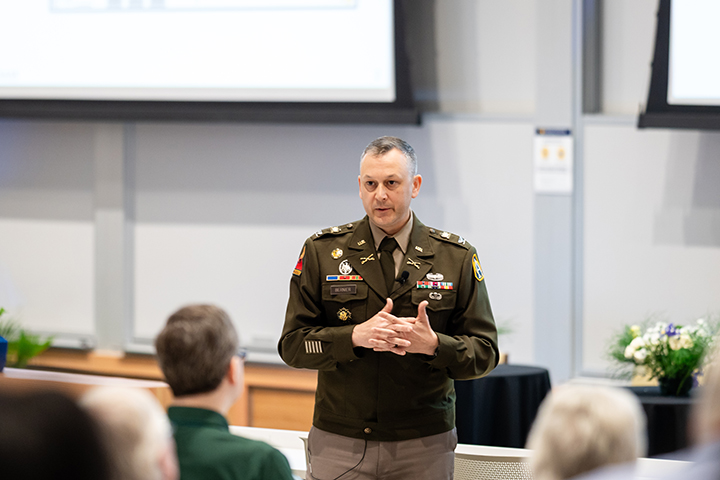
The future battlefield will not be won by individual vehicles operating independently. Instead, success will depend on formations of crewed and autonomous systems capable of sensing, adapting, collaborating, and evolving together to accomplish increasingly complex missions.
That vision formed the foundation of the keynote delivered by Colonel Ken Bernier during the 32nd Automotive Research Center (ARC) Annual Program Review in Ann Arbor, Michigan. Bernier serves as Program Manager for Autonomous Robotic Capabilities within the U.S. Army’s Capability Portfolio Executive - Mission Autonomy.
Throughout his presentation, Bernier described a fundamental shift taking place across Army modernization. The objective, he explained, is no longer simply to develop better robotic systems, but to build integrated formations in which autonomous ground vehicles, robotic sustainment systems, intelligent software, and human operators work together as a single operational capability.
“We’re focused on formations. We’re not focused on things.”
That distinction, Bernier explained, changes everything, from how problems are defined, to how technology is developed, to how capability is delivered to Soldiers.
His remarks directly complemented this year’s ARC Annual Review theme, “Digital Engineering for Automation through AI," illustrating how autonomy, digital engineering, human-centered design, and operational experimentation are converging to reshape future ground operations.
Mission Autonomy Begins with Operational Problems
Bernier explained that Mission Autonomy represents one of the Army’s newest capability portfolios, created in response to both organizational reform and the rapidly changing character of modern warfare. Autonomous systems are no longer viewed as independent technologies. Instead, they are becoming integral components of operational formations designed to deliver battlefield effects through coordinated human-machine teams.
“Interconnecting them is about making them all work together to deliver effects on the battlefield, and not to do it in the future, but to do it now."
Rather than beginning with technical specifications or predefined products, Bernier described a fundamentally different acquisition philosophy. The starting point is no longer: “Build me a robot." The starting point is: “Solve an operational problem." That philosophy has transformed how his organization approaches capability development. Instead of writing lengthy specifications describing exactly how a system should be engineered, Mission Autonomy defines operational challenges and invites industry, government laboratories, and academia to develop innovative solutions. As Bernier observed, the U.S. Army is moving beyond decades of acquisition practices centered on designing the perfect system according to fixed requirements. The emphasis is shifting toward identifying operational needs, encouraging innovation, and rapidly transitioning successful ideas into capability.
“Here is the problem I want you to solve."
For Bernier, this represents one of the most important cultural changes occurring within Army modernization. Innovation begins with understanding the operational challenge—not prescribing the technical solution.
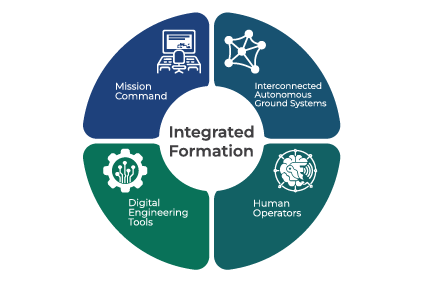
From Individual Robots to Autonomous Formations
Bernier illustrated this philosophy through several operational examples currently driving Army modernization. One focuses on sustainment. Rather than asking how to build another autonomous vehicle, Mission Autonomy asks a broader question: How can Soldiers be removed from some of the most dangerous logistics operations on the battlefield?
Beginning with large, palletized loads, autonomous transportation systems move supplies toward forward operating areas. Smaller robotic platforms then distribute ammunition, fuel, water, and other critical resources during the “last tactical mile,” reducing risk to Soldiers operating near the front lines.
Drawing on observations from ongoing conflicts, Bernier identified breach operations as a critical use case for autonomy. Because breaching fortified obstacles remains one of the most dangerous missions Soldiers perform, Mission Autonomy is pursuing robotic capabilities that could conduct these operations without placing Soldiers directly in harm’s way.
The objective is not merely replacing a human with a robot. It is redesigning the operational problem itself. Across these efforts, the common thread remains consistent. Mission Autonomy seeks to orchestrate multiple autonomous capabilities into integrated operational formations capable of achieving effects that individual systems could never accomplish independently.
Autonomy Must Scale Beyond Individual Platforms
Bernier emphasized that future capabilities will depend upon far more than individual robotic vehicles. They will require a broader operational ecosystem that includes autonomous transportation, autonomous logistics, robotic breaching, ground autonomy, attack systems, and software orchestration.
His organization focuses on synchronizing hardware, software, and operational concepts around mission requirements rather than individual platforms. This philosophy extends to off-road autonomy as well.
Unlike commercial autonomous driving systems designed for structured environments, Army systems must navigate terrain without roads, operate under adverse weather conditions, adapt to changing environments, and continue functioning under combat conditions.
Those challenges remain among the most difficult problems facing autonomy research today. Rather than assuming those problems have already been solved, Bernier challenged the audience to recognize both the progress already achieved and the substantial research opportunities that remain ahead.
“How many of you think off-road autonomy under combat conditions against an enemy has been solved?" Bernier asked. His point was clear: off-road autonomy in contested combat environments remains an unresolved, multidisciplinary challenge, one that will require close collaboration among the Army, academia, and industry.
Engineering an Open and Sustainable Innovation Ecosystem
Bernier returned repeatedly to a second principle that extends beyond robotics.
Future Army capabilities will require more than better technology; they will require a fundamentally different innovation ecosystem.
Historically, major Army platforms evolved around a single prime contractor and a relatively closed development model. While that approach successfully delivered iconic systems such as the Abrams, Bradley, Apache, and Paladin, Bernier argued that future mission autonomy requires a more agile and sustainable innovation model.
We’re focused on “developing an actual, scalable, sustainable business model between us and industry. Because we realize if we cannot do that, this will not last” Bernier said.
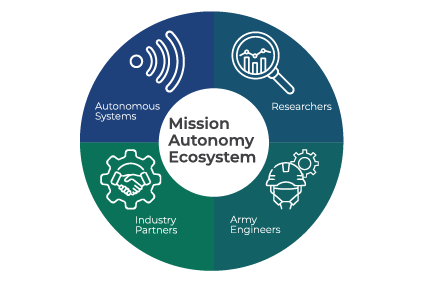
Mission Autonomy seeks to create an ecosystem in which government, industry, and academia continuously contribute new technologies, rapidly integrate emerging capabilities, and sustain innovation over time. That philosophy aligns with the ARC’s long-standing collaborative model.
By framing challenges around operational effects rather than predetermined technical specifications, the Army can create opportunities for nontraditional performers, startup companies, established industry partners, and university researchers to contribute solutions that otherwise might never emerge.
Bernier explained that future capability development depends not only on technological innovation, but also on maintaining an innovation ecosystem capable of continuously generating new ideas.
The Role of Academia
In the discussion that followed, ARC community members and Bernier explored how academic research can support the Army’s evolving autonomy needs. Asked how academic researchers can best support Mission Autonomy, Bernier’s response was direct. Rather than asking universities simply to conduct more research, he encouraged closer engagement with the Army’s operational challenges and technology gaps.
Many of today’s challenges require additional scientific maturation before they are ready for transition into acquisition programs. Government laboratories and research partnerships, including the ARC, provide critical pathways for moving promising ideas from fundamental research toward deployable capability.
For Bernier, that transition process is where academia provides exceptional value.
University researchers explore new concepts, reduce technical risk, investigate emerging technologies, and generate the scientific understanding needed before capabilities are mature enough for acquisition programs. This continuous relationship between discovery, experimentation, maturation, and transition has long been a defining characteristic of the ARC. It ensures that research remains connected to future operational needs while preserving the scientific freedom necessary for innovation.
Engineering Never Ends
Bernier concluded the discussion with a reminder that innovation does not stop once a capability reaches the field. Even successful systems require continued engineering investment to improve reliability, reduce lifecycle costs, enhance maintainability, and increase performance. For Bernier, engineering excellence is rarely achieved through one breakthrough; it emerges through sustained investment, close collaboration, and continuous improvement. Every incremental improvement contributes to a more effective and sustainable capability. He illustrated this philosophy through the evolution of the M240 machine gun. Although early versions experienced significant engineering challenges, decades of deliberate refinement transformed it into one of the most reliable weapon systems in the world. For Bernier, this lesson extends far beyond a single platform. It is the beginning of an ongoing process through which scientific discovery continuously evolves into operational capability. That perspective mirrors the ARC’s own philosophy: research is not an endpoint, but the beginning of a process through which scientific discovery evolves into operational capability.
ARC Leadership Perspective
Bogdan Epureanu, Director of the Automotive Research Center, noted that Bernier’s keynote reflects an important shift in how future engineering challenges are being approached.
“Colonel Bernier’s remarks reinforce an important transformation in engineering research," said Epureanu. “The objective is no longer simply to build better autonomous systems. It is to solve operational problems through integrated autonomy, digital engineering, human-machine teaming, and continuous collaboration. That philosophy closely aligns with the ARC’s mission of advancing the scientific foundations that support future Army capabilities."
Epureanu noted that many of the research areas highlighted during the keynote—including adaptive autonomy, off-road mobility, digital twins, human-machine teaming, intelligent power systems, and formation-level coordination—are active areas of investigation across the ARC consortium.
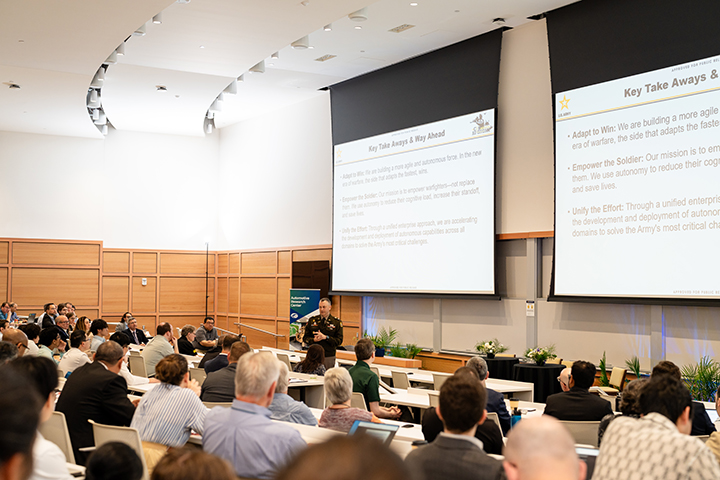
Dr. David Gorsich, Chief Scientist of the U.S. Army Ground Vehicle Systems Center, emphasized that Bernier’s remarks demonstrate how future military capability depends upon integrating advances across multiple technical disciplines rather than treating autonomy as an isolated technology.
“Mission autonomy requires much more than robotics," said Gorsich. “It requires integrating digital engineering, software, sensing, human factors, and operational understanding into cohesive capabilities that can adapt as operational needs evolve. The ARC provides a unique environment where those disciplines come together through sustained collaboration."
From Autonomous Systems to Autonomous Formations
Throughout his keynote, Bernier consistently redirected the discussion away from individual technologies and toward operational outcomes. The future, he argued, is not defined by better robots. Nor is it defined by individual autonomous vehicles operating independently. The future lies in formations—crewed and autonomous systems working together, continuously adapting, sharing information, and delivering operational effects that no individual platform could achieve alone.
Achieving that vision will require more than technological breakthroughs. It will require new acquisition models, new approaches to collaboration, continuous digital engineering, artificial intelligence, open innovation ecosystems, and sustained partnerships among government, academia, and industry.
Those principles have long defined the ARC. By bringing together Army engineers, university researchers, industry partners, and graduate students around shared operational challenges, the ARC provides an environment where emerging technologies can mature into practical capabilities while preparing the next generation of engineering leaders. As autonomous systems continue to reshape military operations, the ARC remains uniquely positioned to help bridge the gap between scientific discovery and operational capability.
For Bernier, that bridge is not built one platform at a time. It is built one formation at a time.