

Boeing Executive William Carter Highlights the Future of AI, Digital Engineering, and Industrial Autonomy at ARC Annual Program Review
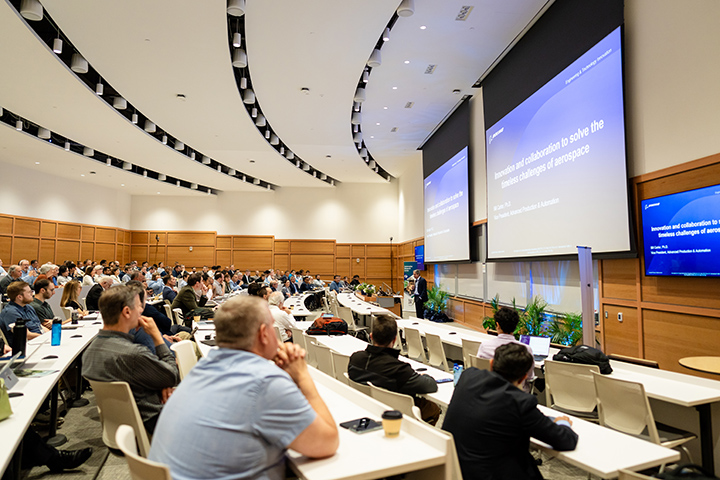
The next revolution in engineering may not occur in the vehicle itself, but in the factory that builds it.
That was a central message from Dr. William Carter, Vice President of Advanced Production and Automation at Boeing Technology Innovation, who delivered the opening keynote at the 32nd Automotive Research Center (ARC) Annual Program Review in Ann Arbor, Michigan. Drawing on experience spanning Boeing, DARPA, and advanced manufacturing research, Carter outlined how digital engineering, artificial intelligence, industrial autonomy, and digital twins are reshaping the future of production systems.
The keynote aligned closely with this year’s Annual Review theme, “Digital Engineering for Automation through AI,” highlighting how advances in modeling, simulation, autonomy, digital twins, and intelligent decision support are creating new opportunities to improve quality, productivity, resilience, and innovation across complex manufacturing ecosystems.
Throughout his presentation, Carter emphasized that while modern vehicles have benefited from decades of engineering optimization, many of the greatest remaining opportunities for transformative improvement lie in manufacturing, quality, supply chain management, and production operations.
“It turns out to be about manufacturing and supply chain and quality and safety. Those are the areas where we still have the opportunity to see 10x improvements," Carter said.
Drawing from his experiences at DARPA and Boeing, Carter reflected on a recurring lesson throughout his career: breakthrough capabilities emerge when engineering disciplines become connected across scales, from materials and manufacturing processes to vehicle performance, mission effectiveness, and operational outcomes.
He described how early work linking materials behavior to vehicle performance helped shape his thinking about digital engineering and systems-level optimization. That perspective continues to influence Boeing’s efforts to connect design, manufacturing, quality, sustainment, and operational performance through increasingly integrated digital environments.
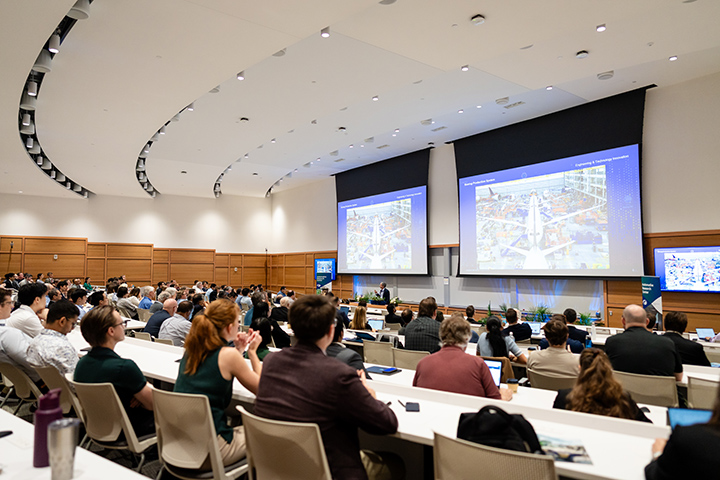
Carter illustrated these challenges through examples from Boeing’s production systems, including the assembly of the 787 Dreamliner. He described the extraordinary precision required to manufacture modern aircraft, where structures approaching 100 meters in size must be assembled with tolerances measured in microns. A seemingly small misalignment can have significant implications for performance, underscoring the importance of precision at scale.
Yet despite the sophistication of modern products, Carter argued that many of the underlying manufacturing challenges are timeless. Referencing a 4,500-year-old Egyptian vessel discovered near the Great Pyramid of Giza, he demonstrated how engineers have long grappled with issues of structural design, materials behavior, manufacturing quality, and system integration.
“Nothing is really new,” Carter noted, observing that innovation often comes not from entirely new concepts, but from new ways of integrating technologies and capabilities.
A recurring theme of the keynote was the importance of connecting information across the entire production ecosystem. Carter described Boeing’s efforts to move beyond fragmented data environments toward a digital factory architecture capable of delivering contextualized information directly to engineers, operators, managers, and decision-makers.
He explained that many production systems have evolved over decades, resulting in disconnected information streams tailored to individual functions. The next step, he argued, is creating shared digital infrastructure that allows data to flow seamlessly across organizational boundaries.
“Once we put down the right highways, we’ve got the right information streams, then we can do some really amazing things really quickly," Carter said. “We are seeing today the ability of people in our production system to do things that they couldn’t do before and do it themselves."
Artificial intelligence plays a growing role in this transformation. Carter described AI-enabled tools that help workers access information, generate insights, identify emerging issues, create visualizations, and support operational decision-making. Rather than replacing people, these systems are intended to augment human expertise and accelerate problem solving.
“No matter what we see in the future in terms of automation and other AI-enabled capability, the factory and the production system is still going to be human-centric," Carter said. “At the end of the day, there is going to be a set of humans who need information in order to do their work."
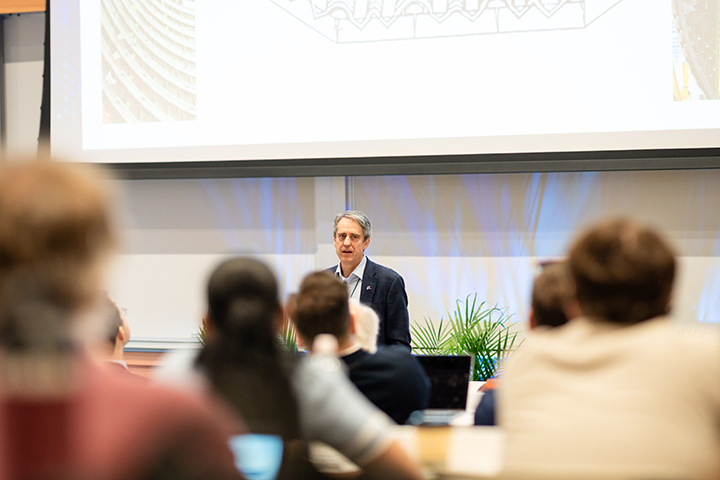
The keynote also explored the growing role of digital twins, intelligent robotics, AI-enabled inspection, and industrial autonomy. Carter described a future in which manufacturing systems become increasingly capable of monitoring their own performance, identifying anomalies, adapting to changing conditions, and continuously learning from operational experience.
“Thinking about a digital twin of our production system, of the part that’s being produced, thinking about multiple robots that are coming together," Carter said while describing Boeing’s vision for future production environments.
He outlined several capabilities that remain important challenges for the future, including autonomous execution, real-time inspection, adaptive manufacturing processes, and learning systems capable of responding intelligently to uncertainty and variation during production. These themes resonated strongly with many of the research areas represented throughout the ARC Annual Program Review.
ARC Director Perspective
Prof. Bogdan Epureanu, Director of the Automotive Research Center, noted the strong alignment between Carter’s keynote and the ARC’s research mission.
“Dr. Carter’s keynote highlighted many of the same challenges and opportunities that motivate ARC research today," said Epureanu. “The convergence of digital engineering, artificial intelligence, autonomy, digital twins, and human-machine systems is creating new possibilities for how complex systems are designed, manufactured, operated, and sustained. These are areas where the ARC community is making important contributions alongside partners from government and industry."
From Digital Factories to Intelligent Manufacturing Ecosystems
Carter concluded by reflecting on the role of innovation in addressing increasingly complex engineering challenges. He emphasized the importance of embracing new ideas, managing risk intelligently, and fostering cultures capable of producing transformative rather than incremental advances.
At the heart of his message was a belief that the future of manufacturing will depend on integrating advanced computation, AI, digital engineering, manufacturing science, and human expertise into unified systems capable of learning and adapting over time.
GVSC Perspective
Dr. David Gorsich, Chief Scientist of the U.S. Army Ground Vehicle Systems Center, noted that the keynote demonstrated the growing convergence between advanced manufacturing, autonomy, and digital engineering across both commercial and defense sectors.
“The future capabilities of complex systems will depend not only on how they are designed, but also on how they are manufactured, sustained, and continuously improved," said Gorsich. “The themes highlighted by Dr. Carter reinforce the importance of digital engineering, data-driven decision making, and human-machine collaboration in creating resilient and adaptable systems for the future."
As the Annual Program Review continued, Carter’s keynote provided participants with a compelling vision of how one of the world’s leading aerospace companies is approaching the challenges of manufacturing in the age of artificial intelligence. His remarks underscored a central message of the conference: the future of engineering will depend on the ability to integrate digital technologies, human expertise, and autonomous systems into cohesive, trustworthy, and adaptable solutions.