

Vehicle Controls & Behaviors
Annual PlanA Hybrid Controller with Observation and Decision Making for Autonomous Mobility Control System
Project Team
Principal Investigator
Project Summary
Principal Investigators
- Masood Ghasemi (PI), Vladimir Vantsevich, Lee Moradi (Co-PIs), University of Alabama, Birmingham
Government
- Jill Goryca, Amandeep Singh, U.S. Army GVSC
Industry
- Tom Canada, Southern Service Company
Project #1.A82 began mid-2020 and was completed Q1 2022.
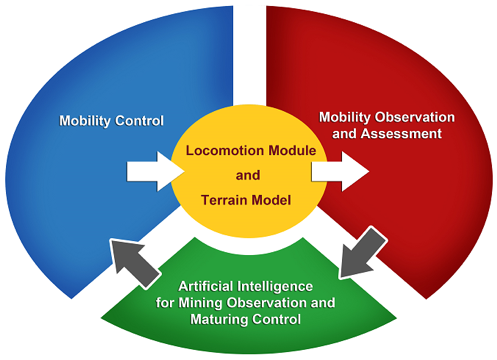
The purpose of this project is to develop research fundamentals of a autonomous mobility control system (AMCS) with:
- an adjustable mobility control algorithm that is able to effectively operate in different severe terrains within an appropriate response time and, thus, to prevent the tire spinning,
- observation algorithms that are able to provide on-line states of the locomotion module’s normal, longitudinal, and rotational dynamics, and
- an Artificial Intelligence (AI) - based learning component that is able to learn from the observers’ data in real-time and improve/mature the mobility control parameters .
The goal is to mathematically design and demonstrate in computational simulations the autonomous mobility control system that functionally integrates the above-listed three components. This will be done for a locomotion module that is an assembly unit/corner of a Joint Light Tactical Vehicle (JLTV).
Experimental and analytical data researched in “Instant Tire Slippage Characterization with Digital Image Correlation for Autonomous Mobility Applications” was used in this project.
1.A82
Publications:
Ghasemi, M., Vantsevich, V. V., Gorsich, D. J., & Moradi, L. (2021). Robust Control Design for a Single-Wheel Module Operating in an Off-Road Terrain with Uncertain and Stochastic Attributes. IFAC-PapersOnLine, 54(20), 624-631.
Vantsevich, V. V., Gorsich, D. J., Paldan, J. R., Ghasemi, M., & Moradi, L. (2022). Terrain mobility performance optimization: Fundamentals for autonomous vehicle applications. Part I. New mobility indices: Optimization and analysis. Journal of Terramechanics, 104, 31-47.