

Human-Autonomy Interaction
Annual PlanDynamic Task Allocation and Understanding of Situation Awareness Under Different Levels of Autonomy in Closed-Hatch Military Vehicles
Project Team
Principal Investigator
Cindy Bethel, Mississippi State University Daniel Carruth, Mississippi State UniversityGovernment
Victor Paul, U.S. Army GVSC
Industry
Andrew Bird, Neya Systems
Student
Jessie Cossitt, Viraj Patel, Mississippi State U.
Project Summary
Project begins in 2020, estimated duration of 3 years.
This research is based around the need to better understand how humans and autonomous vehicles can work together in order to provide the best case scenario for the successful completion of military missions and utilization of autonomous capabilities. Previous attempts to determine optimal allocation of tasks have allocated the tasks statically. This is not an ideal method for task allocation although it is manageable and more easily implemented.
Fundamental research questions include:
RQ1: How are driver cognitive load, situation awareness, and task performance impacted when receiving a controlled frequency of independent task requests at different levels of autonomy?
RQ2: How are driver cognitive load, situation awareness, and task performance impacted when receiving varied and increasing frequency of independent task requests at different levels of autonomy?
RQ3: How does dynamically optimized frequency of independent task requests enhance driver cognitive load, situation awareness, and task performance under different levels of autonomy?
The research effort focuses on the use and evaluation of dynamic task allocation based on human-computer interaction concepts and physiological responses during multi-modal dynamic task requests in military missions. This effort is one of the first to investigate comprehension of road events under different levels of autonomy in virtual reality simulations.
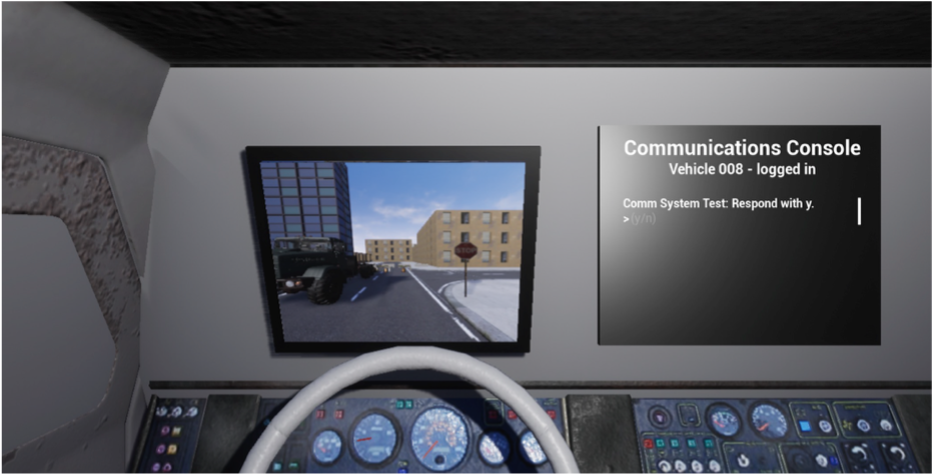
Effects of automation on vehicle crew member primary and secondary task performance and ultimately the optimization of an intelligent system for allocating secondary tasks across crew members will be studied. There is significant interest in how automated driving systems may allow a vehicle operator to address secondary tasks. This project investigates how such a system will affect the operator’s ability to monitor the primary driving task and respond if human intervention is required. Improved understanding of how automation and increased secondary tasking affect operator performance leads to improved system designs that support effective management of crew member cognitive resources and tasks. Effective task allocation is critical to efforts to reduce the number of crew members using automation.
Publications:
- J. E. Cossitt, C. R. Hudson, D. W. Carruth, C. L. Bethel, “Dynamic Task Allocation and Understanding of Situation Awareness Under Different Levels of Autonomy in Closed-Hatch Military Vehicles”, In Proceedings of the Ground Vehicle Systems Engineering and Technology Symposium (GVSETS), NDIA, Novi, MI, Nov. 3-5, 2020.
- J. E. Cossitt, V. R. Patel, D. W. Carruth, V. J. Paul, C. L. Bethel, “Developing a Model of Driver Performance, Situation Awareness, and Cognitive Load Considering Different Levels of Partial Vehicle Autonomy”, In Proceedings of the Ground Vehicle Systems Engineering and Technology Symposium (GVSETS), NDIA, Novi, MI, Aug. 16-18, 2022.
- J. E. Cossitt, “Developing a Model of Driver Performance, Situation Awareness, and Cognitive Load Considering Different Levels of Partial Vehicle Autonomy,” Ph.D. dissertation, Bagley College of Engineering, Mississippi State University, 2022.
- J. E. Cossitt, V. R. Patel, D. W. Carruth, C. L. Bethel, “Modeling Operator Performance Considering Autonomy Level in Partially Autonomous Vehicles”, In Proceedings of Interservice/Industry Training, Simulation and Education Conference (I/ITSEC), Orlando, FL, Nov. 28-Dec. 2, 2022.
- V. R. Patel, “Using Dynamic Task Allocation to Evaluate Driving Performance, Situation Awareness, and Cognitive Load at Different Levels of Partial Autonomy,” Master’s Thesis, Bagley College of Engineering, Mississippi State University, 2023.
2.14