

Systems of Systems & Integration
Annual PlanAutonomous Multi-UAV Reconnaissance in a Complex Environment
Project Summary
Principal Investigators
- Carlo Pinciroli (PI), Worchester Polytechnic Institute
- Lee Moradi (co-PI), WPI
Students
- Antonio Lopez, Davis Catherman, WPI
Government
- Philip Frederick, Jon Smereka, Graham Fiorani, U.S. Army GVSC
Industry
- Iain Dodds, VI Grade
- Alyssa Scheske, Applied Intuition
Project #5.A126 began in end-2024.
We specifically focus on reconnaissance in small urban environments (i.e., a village) where obstacles and factors such as fog and dust limit navigability and visibility for any individual robot. Additionally, hidden threats may be present and need to be found. These operational conditions make it critical to consider the probability of failing a reconnaissance task, which in turn requires the ability to reassign reconnaissance tasks on-the-fly. Consequently, our goal is to maximize coverage along with the probability of success, while minimizing completion time. However, these goals are contradictory. More coverage implies longer completion time and a lower probability of success, whereas a higher probability of success means that multiple robots might perform the same task multiple times, which negatively impacts completion time.
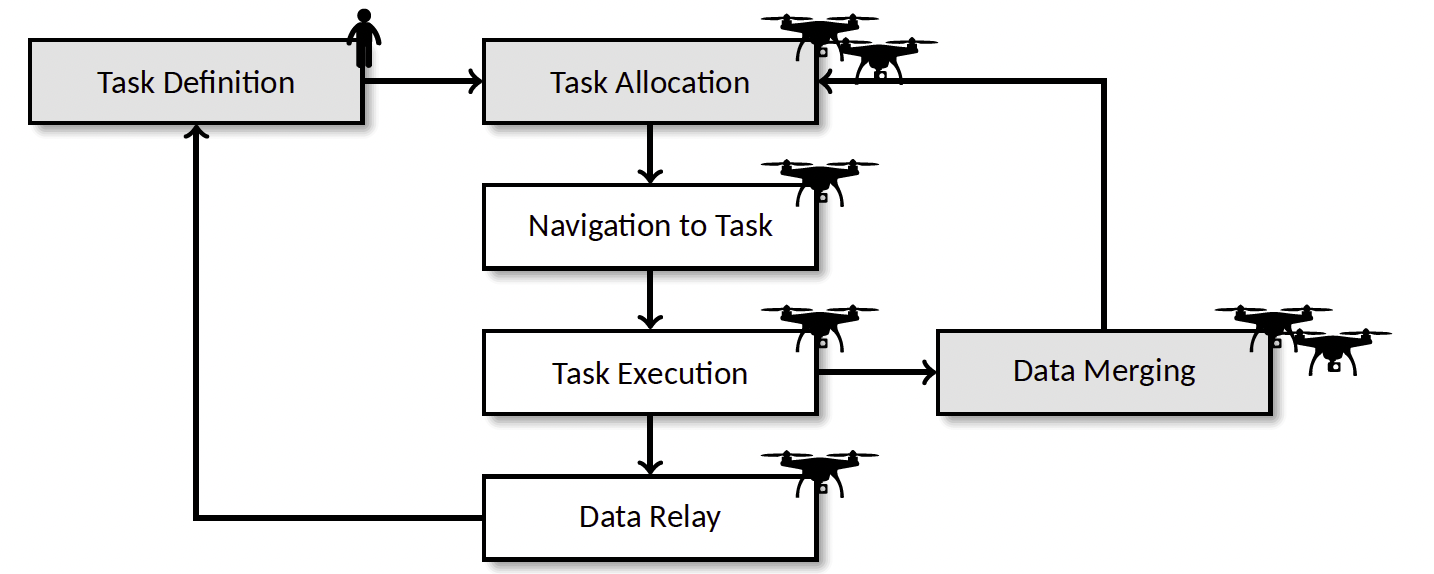
The high-level structure of the work in this project is reported in the above figure. The operations start with the Platoon Leader defining the reconnaissance tasks to be performed by the drones (Task Definition). The drones take off, and autonomously perform two operations (Task Allocation): (a) They negotiate tasks across the swarm, and (b) They schedule time and location of meetings to merge data. Subsequently, the drones navigate to their assigned tasks (Navigation to Task) and perform their tasks (Task Execution). Upon completion of a task, the drones either relay the data to the Platoon Leader (Data Relay) or attend a meeting to merge data with other drones (Data Merging).
Task Definition, Task Allocation and Data Merging (gray boxes in figure) indicate the focus of our research. The remainder (Navigation to Task, Task Execution, Data Relay) are covered by existing work or complimentary projects.
Objective 1: Task scheduling for fallible robots The first research objective deals with task allocation under the assumption that the robots might fail at completing their task. This scenario poses two main questions:
O1.1. What formalism best captures the essence of task scheduling when failures occur? Traditional methods that produce deterministic schedules do not suffice, since they are best suited for planning before execution, rather than planning during execution in response to adverse events.
O1.2. How to form teams, possibly composed of UAVs with heterogeneous capabilities, that maximize the probability of success given the task definition and the available information? This is not a problem of task scheduling, but rather a problem of co-design — of the best initial schedule, and of the best team to execute it. This problem has never been studied in the literature before.
Objective 2: Data Management in Sparse Swarming Once the swarm is deployed, it is unrealistic to assume that the UAVs will maintain connectivity for the duration of the mission, making the swarm topologically sparse. On the other hand, the need to dynamically cope with failures and the need to replan make communication a requirement. To tackle these issues, we will study how to schedule informative meetings in a safe location, where the robots meet and merge their data. We will consider two research questions:
O2.1. When and where to meet? Regarding when, the intuition is that there is an optimal time period to meet. Meeting is an expensive activity that should be done only when a sufficient amount of useful information has been gathered; however, information might also be time-sensitive (e.g., a critical task failure). Regarding where, the challenge is to mark already mapped locations that experience no danger and no jamming, and navigate there efficiently.
O2.2. How to efficiently store and merge important data? Because of failures, we want to prevent critical data from being stored by a single robot. Instead, we want data replication. The intuition is that the swarm acts as a sort of mobile cloud computing system, which must process and store information to prevent loss and delays. Data structures for this purpose do not exist, and this project will pioneer their creation.
5.A126